If you are having trouble with grief issues and would like some help and advice as you go through the different stages of grief, please do not hesitate to contact me by doing the following:
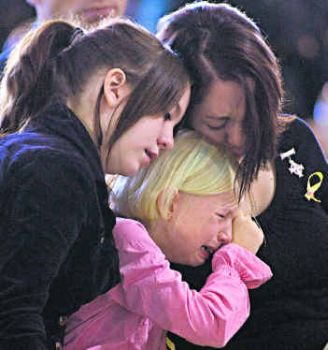
When someone that we love dies we feel an indescribable pain. Some have described it as a "pit" or a "hole" in the stomach. It is as if someone cut off our right arm. And I think it is so severe because we know that once someone dies, they are gone forever and there is nothing we can do about it. Not all the money, talent, or resources in the world can bring them back from death. It is the most "helpless" of feelings.
How the person died, and the age that they died also plays a part in how we grieve. If the death was tragic, or an accident, or because of a terminal illness, or if the person who has died is fairly young, or a child, or had many good years left, it is equally devastating.
We go through feelings of guilt wishing that we could have prevented their death. We ask ourselves the "what ifs" which never really solve anything other than to make us feel worse.
The only thing we can do is learn how to think about it in our hearts so that we are not destroyed while we grieve.
1.) What is grief?
Grief is a reaction to loss. While we often think of grief in terms of death, we can also grieve losses from divorce or a terminal illness. We may grieve the loss of a friendship, or a relationship with a family member, or a loved pet. We may even grieve the loss of a place that we lived, or a lifestyle that we used to have. We can grieve the loss of youth, or middle age. We often think of grief in terms of feelings such as anger, guilt, sadness or loneliness. But grief affects us in other ways as well -- spiritually, behaviorally, physically, and mentally.
2.) Are there stages to the grief process?
Well, there are certain emotions that we go through, but they come in waves, rolling in and out of our lives, usually when we least expect it. There are times when we think we are doing better, and then "wham" out of nowhere we are remembering the loss, and the pit in our stomach returns.
There are five stages to the grief process but while they follow a certain order, many times they come in no particular order at all.
a.) Denial & Isolation: When tragedy strikes, we have a hard time believing it. It can take years to come to grips with the death of a loved one. We may deny that the loss has taken place, refusing to believe the reality of it. This may cause us to withdraw from our usual schedules, such as work, friends, and daily activities. We can stay in this stage for days, weeks, or months pretending that "everything is fine" and will even refuse to talk about the situation.
b.) Anger: After we get past denial then we become very angry. We can get angry at the person for dying and leaving us, we can get angry at God for not keeping them alive, we can get angry at what or whoever killed them, and we can get angry at ourselves for not preventing their death. We even get angry at the entire world.
c.) Bargaining: When our anger gets us no where but more upset, we begin to bargain with God. We make promises and deals with God, "if only he would bring them back to life." We may offer to God to do or not do something if He will only bring them back.
d.) Depression: And then when all of our deals and promises do not bring them back we get depressed. This is where many people give up and do careless things, like not go to work, or talk to others, or eat, or not eat, etc. The individual feels numb, although anger and sadness may remain underneath. An individual may lose interest in pleasurable activities, feel sad for days at a time and truly mourn for their loss.
This is the point that we need to talk to a Pastoral Counselor who can restore our hope and faith not only in God, but help us to believer that we will be reunited with our loved ones once again.
e.) Acceptance: Finally we accept the loss. We realize that we cannot bring the loved one back, and we have to go on with our lives. When we reach the level of acceptance, we have found peace.
3.) Does grief have a timetable?
Since grief is such an individual reaction, it is hard to give a timetable. For most people, the most intense grief is for the first two years. After that, low periods tend to be less frequent and intense. But even years after a loss, especially at the anniversary or birthday of the person's death, or the end of a relationship, or special events such as a family wedding or the birth of a child, we may still experience a sense of grief. Sometimes, just seeing something that reminds us of the other person is a "trigger" that can start the entire process over again.
4.) Do we grieve in different ways?
Each of us grieves in our own way, affected by our inborn temperaments, our faith, or lack of faith, our relationship with the person who died, circumstances surrounding the loss, our present circumstances, our coping skills, and the support systems that we have in place. Every loss has a unique meaning to us. Some may experience grief primarily as waves of feeling; others may manifest grief in the ways they think or physically feel.
5.) How much grief is normal? When is grief not normal?
At any point, a pastoral counselor who does grief work might help in sorting out reactions and ways that we are adapting to grief. In cases where expressions of grief are destructive to self or to others, or we become suicidal, or in situations where the grief is highly disabling (that is, we find it difficult to care for ourselves, others or to function in our daily lives), it is imperative that we consult a Pastoral Counselor. When we experience certain types of losses such as traumatic loss or the loss of a child, we would benefit from intervention and support groups such as " Grieving Parents."
If you find yourself unable to cope with your grief on your own, please write your thoughts and feelings to me via e-mail counseling, or you may schedule a Telephone Counseling Session with me, and together we will help you get through this. Please see below for instructions on how to contact me.
Patricia Jones, M.A.
Brothers, we do not want you to be ignorant about those who fall asleep, or to grieve like the rest of men, who have no hope. We believe that Jesus died and rose again and so we believe that God will bring with Jesus those who have fallen asleep in him. Thessalonians 4:13, 14
For the LORD comforts his people and will have compassion on his afflicted ones. Isaiah 49:13b
When you pass through the waters, I will be with you; and when you pass through the rivers, they will not sweep over you. When you walk through the fire, you will not be burned; the flames will not set you ablaze. Isaiah 43:2
May our Lord Jesus Christ himself and God our Father, who loved us and by his grace gave us eternal encouragement and good hope, encourage your hearts and strengthen you in every good deed and word. 2 Thessalonians 2:16,17
Blessed are those who mourn, for they will be comforted. Matthew 5:4
Praise be to the God and Father of our Lord Jesus Christ, the Father of compassion and the God of all comfort, who comforts us in all our troubles, so that we can comfort those in any trouble with the comfort we ourselves have received from God. 2 Corinthians 1:3,4
The Spirit of the Sovereign LORD is on me, because the LORD has anointed me to preach good news to the poor. He has sent me to bind up the brokenhearted, to proclaim freedom for the captives and release from darkness for the prisoners, to proclaim the year of the LORD's favor and the day of vengeance of our God, to comfort all who mourn, and provide for those who grieve in Zion-- to bestow on them a crown of beauty instead of ashes, the oil of gladness instead of mourning, and a garment of praise instead of a spirit of despair. They will be called oaks of righteousness, a planting of the LORD for the display of his splendor. Isaiah 61:1-3
My comfort in my suffering is this: Your promise preserves my life. Psalm 119:50
Cast all your anxiety on him because he cares for you. 1 Peter 5:7
"Where, O death, is your victory? Where, O death, is your sting?" The sting of death is sin, and the power of sin is the law. But thanks be to God! He gives us the victory through our Lord Jesus Christ.1 Corinthians 15:55-57
Even though I walk through the valley of the shadow of death, I will fear no evil, for you are with me; your rod and your staff, they comfort me. Psalm 23:4
For we do not have a high priest who is unable to sympathize with our weaknesses, but we have one who has been tempted in every way, just as we are--yet was without sin. Let us then approach the throne of grace with confidence, so that we may receive mercy and find grace to help us in our time of need. Hebrews 4:15,16
We accept PayPal and all other major credit or debit cards. Once you hit the PayPal button it will allow you to pay with PayPal or another major credit or debit card. No PayPal account is required.